Every site defines its own button: likes, stars, upvotes, hidden dislikes, private counters. Emojery adds one independent reaction layer across all of them.
Native buttons do not mean one thing
Every platform chooses a different contract
A Like on Facebook, a Star on GitHub, an upvote on
Reddit, a
hidden dislike on YouTube, and a product rating on Amazon are not interchangeable. They look similar because they are small buttons near content, but each one has a different meaning, a different visibility model, and a different relationship to the platform's
ranking, profile, notification, or recommendation systems.
That inconsistency is the problem Emojery is designed around. People already react to the web all day. The web just does not give them one clear, portable way to leave a lightweight public signal. Reddit is a sharp example: sometimes you want a reaction without pressing the native upvote or downvote.
Linking the two layers when you want both
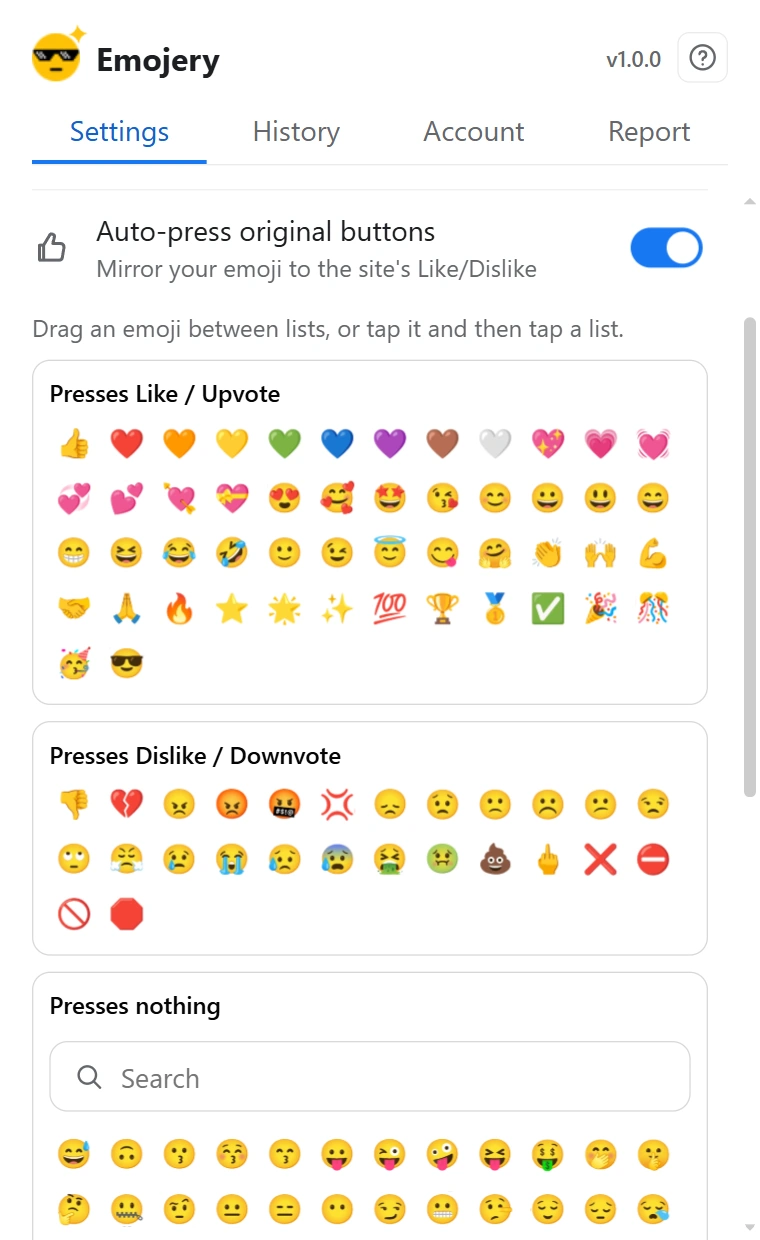
The layers don't have to stay separate. The off-by-default Auto-press original buttons setting makes one emoji pick do both jobs: a positive emoji also presses the site's Like, upvote, or Star, a negative one presses Dislike or downvote where the site has one, and on
Facebook an exact match sets the matching native reaction (❤️ becomes Love, 😆 becomes Haha). You decide which emoji count as which by dragging them between 3 lists in the popup, un-reacting releases only what the extension itself pressed, and the presses are real, with the
same platform effects as your own click.
Auto-press original buttonsOff until you switch it on. Drag any emoji between the 3 lists to decide what it presses. Click to enlarge.
Native reactions vs Emojery
Question
Native reactions
Emojery
Palette
A handful of approved icons chosen by the platform
Delete your Emojery account at any time; your reactions reverse out of the counts
A generic reaction contract for the web
One target, one current reaction
Emojery treats a public item as a target: a repo, post, video, product, or other supported page object. A verified account can have one current reaction for that target. Changing your mind updates the reaction; removing it takes it out of the count.
Same interaction model across sites
The page layout still belongs to the site, but the reaction model stays familiar. Open the picker, choose an emoji, see aggregate counts, and use the same account model across supported websites. That is the "generic web contract" Emojery is aiming for: not a formal standard, but a clear user-facing
rule that does not reset every time a platform changes its own buttons.
The picker is the easy half. A browser toolbar like Instant Emoji Reaction will hand you emoji on any page in a few kilobytes — what neither it nor a native button gives you is the other half: a shared target everyone's tap lands on, and a count that
survives leaving the page.
Verifiable counts, not another black box
The count is only useful if it means something. Emojery backs counts with a public, append-only log and an open-source verifier that can recompute totals. The public API plan is built around the same principle: expose aggregate reaction data without turning it into a user lookup service.
What Emojery does not replace
Native actions still have their place
A GitHub Star can still bookmark a repo. A Facebook Like can still be the native Facebook action. A YouTube Like can still train YouTube's own interface. Emojery is not trying to pretend those controls have no value. It adds a second, independent signal when the native button is too limited or too
platform-specific for what you want to express.
Comments and reviews still matter
An emoji cannot explain a bug report, a product defect, a legal concern, or a thoughtful review. It is a quick signal, not a replacement for writing. The advantage is speed: a reaction can say something useful in one second without dragging every page into another comment system.
When the page does need words, the mature tools are the annotation and comment layers:
Hypothesis anchors highlights and scholarly notes to a passage, and Comment Anywhere bolts a thread onto any URL. Both ask a reader for a sentence; Emojery asks for one tap, which is why the counts add up to something a thread never
does.
Use the site's buttons when they fit. Use Emojery when they do not.
Install the extension and keep the web's native controls available by default. When a Like, Star, or upvote is too narrow, choose the reaction you actually mean.